


Every few months, the same conversation happens in boardrooms and marketing reviews. Sales are flat, someone says “we need more leads,” and the advertising budget goes up, while the customer acquisition system behind it stays untouched.
Sometimes that is the right call. Very often, it is not.
If you run an established business, one with a sales team, an advertising budget and enquiries already arriving from more than one channel, the real issue is rarely lead volume. It is what happens to those leads after they arrive. A weak customer acquisition system turns every extra rupee of ad spend into more enquiries that nobody answers quickly, qualifies properly or follows up on.
Many business owners, founders, CEOs and marketing heads will recognise this pattern. The campaigns are running, the enquiries keep coming in and the reports look busy, yet the sales figures do not reflect the effort. Marketing seems to generate activity, but not enough business.
This article looks at why that happens. You will see how to spot the warning signs, why adding more leads can actually make things worse, what a connected customer acquisition journey looks like, and the order in which to fix it. Take a few minutes with it, because the answer may change where your next rupee of marketing budget goes.
The Problem Isn’t Always Lead Generation
When growth stalls, lead generation is the easiest thing to blame, because it is the easiest thing to see. Here is why businesses keep reaching for it:
• Lead generation is visible. You can count leads, compare cost per lead and report on them every week. A drop in enquiries is obvious, so the fix seems obvious too: bring in more.
• Conversion problems are hidden. They sit in missed calls, delayed WhatsApp replies, scattered spreadsheets and sales conversations that quietly go cold.
• Lost enquiries never show up. Nobody reports on the enquiry that was never answered, so the loss does not appear on any dashboard.
• Spend follows what is visible. Businesses keep investing in the visible step and ignore the invisible ones.
This is the uncomfortable idea at the centre of this article: businesses often try to solve a conversion problem by generating more leads.
It feels like progress, because the numbers at the top go up. But if the problem sits further down the journey, the extra leads simply arrive at the same broken process.
Think of a bucket with holes in it. Pouring in more water does not fill it faster. You just waste more water. The same logic applies here:
More leads × a broken conversion process = more wasted leads
So the better question is not “How do we get more enquiries?” It is “What happens to the enquiries we already have?”
The answer usually sits between lead generation and conversion, and that is where the rest of this article focuses.
What Happens After a Lead Enters Your Business?
This is the most important section to understand, because it shows where most customer acquisition systems actually lose business. Follow a single lead through your company and you will usually find a chain like this:
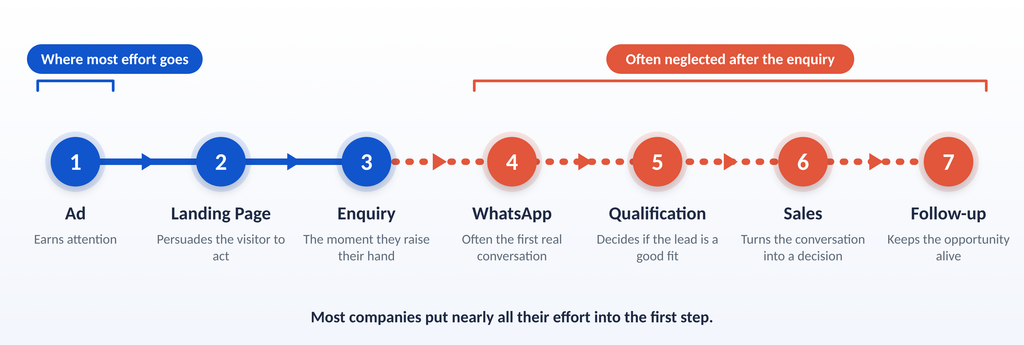
Each link has a job. The ad earns attention. The landing page persuades the visitor to act. The enquiry is the moment they raise their hand. WhatsApp is often where the first real conversation happens. Qualification decides whether the lead is a good fit. Sales turns the conversation into a decision. Follow-up keeps the opportunity alive when the decision takes time.
Most companies put nearly all their effort into the first link. They test creatives, adjust targeting and chase a lower cost per lead. Everything after the enquiry runs on habit. The result is a journey that is polished at the start and neglected from the middle onwards.
Here is what often goes wrong after the click:
- The landing page asks for too much, or says too little, so visitors leave without enquiring.
- The enquiry lands in an inbox or a shared phone that nobody owns.
- The first reply arrives hours later, after the prospect has already spoken to a competitor.
- Sales gets every lead in one pile, with no sense of who is serious.
- Follow-up depends on individual salespeople remembering to do it.
Each gap looks small on its own. Together, they decide whether your marketing spend becomes revenue or just activity. A customer acquisition process is only as strong as its weakest handover, and the handovers after the enquiry are the ones most businesses never look at.
5 Signs Your Customer Acquisition System Is Broken
Not sure whether your problem is lead volume or lead conversion? These five signs usually give the answer. Read them with your own business in mind, and notice how many sound familiar.
You’re Generating Leads, But Sales Aren’t Increasing
This is the clearest signal. Lead numbers are up, reports look healthy, and revenue has not moved. Marketing says it is delivering, sales says the leads are poor, and both teams are looking at the same numbers with different conclusions.
When this happens, the breakdown is almost always between the enquiry and the closed deal, not before it. More lead generation will not close that gap. Understanding the gap will.
Your Sales Team Is Slow to Follow Up
Speed shapes how seriously a prospect takes you. Lead response time is your first impression, and it is formed early, often before anyone from your team has said a word.
A prospect who enquires at 11 a.m. and hears back at 4 p.m. has already formed an opinion about how you will treat them as a customer. Slow follow-up is rarely a motivation problem. It usually means there is no clear owner, no alert and no routine for new enquiries.
Leads Are Scattered Across Different Channels
Enquiries arrive through website forms, Meta ads, Google ads, phone calls, WhatsApp messages and walk-ins. If each channel lives in a different place, nobody sees the full picture.
Leads get missed, duplicated or contacted twice by different people. Reporting becomes guesswork, because no one can say how many enquiries came in this month, let alone which ones were answered. Good lead management starts with one clear path for every enquiry, whatever its source.
Your Website Generates Traffic but Few Enquiries
If people visit but do not enquire, either the audience is wrong or the page is failing to convince. Buying more traffic fixes neither of these. It only brings more visitors to the same page that is not persuading them.
Landing page conversion deserves attention before the next increase in ad spend. A clear offer, a simple form and a message that matches the ad can change results without adding a single rupee to the budget. A slow or unstable page can also cost you enquiries, and Google’s Core Web Vitals give site owners a way to measure loading speed, responsiveness and visual stability.
Nobody Knows Which Marketing Efforts Actually Produce Customers
Ask one question: which campaign produced last month’s paying customers, not just last month’s leads? If the answer is a guess, you cannot invest with confidence. You may be increasing spend on the channel that brings the most enquiries, while the channel that brings the most customers goes underfunded.
Tracking has to run from the first click to the closed sale, which is where tools such as conversion tracking in Google Ads earn their place. Without it, every budget decision is a bet.
If two or more of these signs sound familiar, your system needs repair before it needs more fuel.
More Leads Can Actually Make the Problem Worse
Here is the uncomfortable part. Adding leads to a system that cannot handle them does not just fail to help. It actively damages results.
Imagine your team can properly handle 100 leads a month, with timely replies, real conversations and consistent follow-up. Now your advertising brings in 500.
Four hundred leads wait longer than they should. Response times stretch. Salespeople rush conversations or skip the difficult ones. Prospects who were interested yesterday lose interest. Your team starts saying lead quality is poor, when the leads simply never got a fair chance.
The chain reaction looks like this:
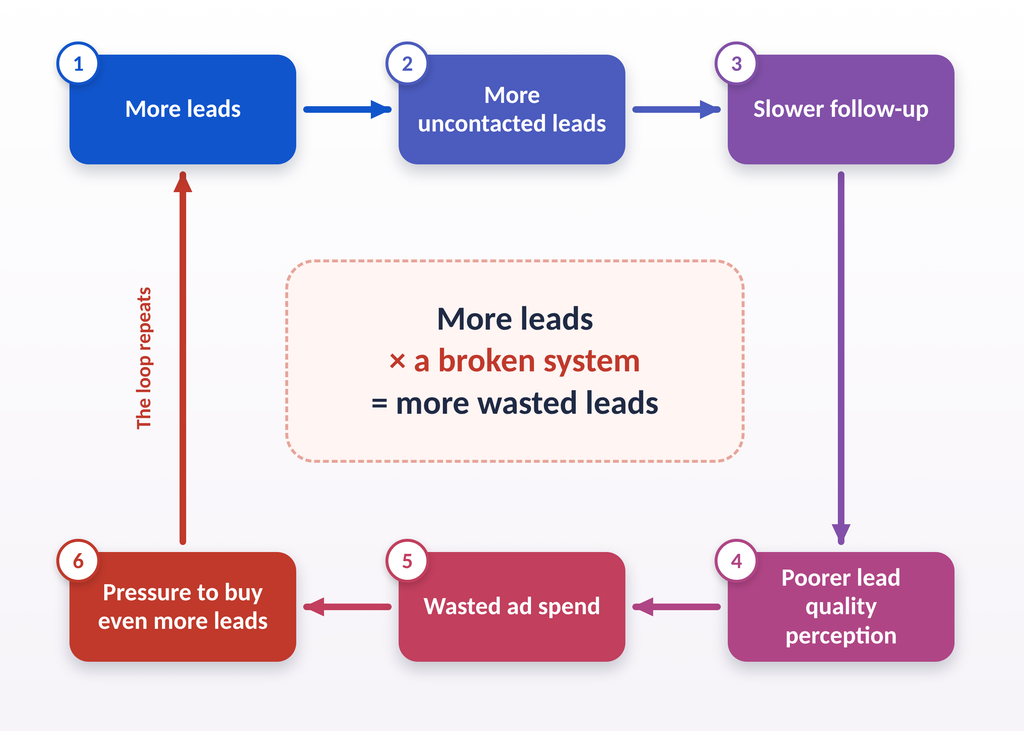
Read it slowly, because every step feeds the next. Uncontacted leads slow the follow-up. Slow follow-up lowers the quality of the conversations. Poor conversations make the leads look weak. Weak-looking leads convince leadership that the answer is more of them, and the loop starts again at a higher cost.
Many businesses are stuck in this loop without realising it. They treat every cycle as a lead generation problem when it is really a capacity and process problem. Before raising spend again, it helps to plan your digital marketing budget around the whole journey, not just the top of it.
What a Connected Customer Acquisition System Looks Like
A strong customer acquisition strategy treats advertising, website, messaging and sales as one journey rather than separate departments. When each team or vendor optimises its own piece, the handovers between them are nobody’s responsibility, and that is where leads disappear. A connected system fixes this by designing the whole path together.
At Greenwill Techs, we think about it in six connected stages:
| Stage | What it covers | Purpose |
| Attract | Meta ads, PPC, LinkedIn and content, backed by strong creative design | Bring in the right people, not just more people |
| Capture | Website and landing pages | Turn attention into clear enquiries |
| Connect | Start a conversation immediately, on a familiar channel | |
| Nurture | Automation, follow-up and email marketing | Keep interested prospects warm |
| Convert | Sales team and CRM | Close well-qualified opportunities with full context |
| Measure | Tracking and analytics | Show which efforts produce customers |
Here is how the stages work together:
Attract brings in the right audience through ads and content. The aim is relevance, because the wrong traffic creates enquiries that never turn into customers.
Capture is the website and landing page. It takes the attention the ad earned and turns it into a clear enquiry.
Connect is where WhatsApp starts the conversation straight away, on a channel customers already use. Meta’s ads that click to WhatsApp are one way to open that chat straight from a Facebook or Instagram ad.
Nurture keeps interested prospects warm through automation and follow-up, so that people who are not ready today are not lost.
Convert is where the sales team, working with a CRM where one is in place, picks up well-qualified opportunities with full context.
Measure closes the loop with tracking and analytics, showing which efforts produce customers so that budget moves to what works.
The value is not in the six labels. It is in the handovers. When one stage is missing or disconnected, the whole customer journey weakens, however strong the other stages are.
Where WhatsApp Fits Into the Customer Acquisition Journey
This section is a supporting piece of the bigger picture, not the whole story. But for many Indian businesses, WhatsApp is already where customers prefer to talk. In a 2025 Kantar survey commissioned by Meta, covering 22 markets including India, 73.3 percent of consumers said they prefer messaging when communicating with a business. That makes it a natural bridge between a first enquiry and a first sales conversation.
Used well, WhatsApp automation supports the journey in five ways:
Immediate response: Every enquiry gets an instant acknowledgement, even outside working hours, using tools such as greeting and away messages, so the prospect knows their message has arrived and that someone will follow up.
Lead qualification: A few simple questions about requirement, budget range or timeline help sort serious prospects from casual ones before a salesperson spends time on them.
Automated answers: Common questions on pricing, location or process get instant replies, freeing your team for conversations that need a human.
Follow-up: Timely check-ins mean interested prospects are not forgotten when the team is busy with other conversations.
Sales handover: When a prospect is ready, the conversation passes to a salesperson with the history intact, so the customer does not have to repeat themselves.
If your business already uses a CRM, the WhatsApp journey can be connected to your existing sales workflow, so conversations and lead status stay visible in the system your team already trusts.
WhatsApp is one part of the system, not the whole answer. It works best when the ads, landing pages and sales process around it are also in good shape.
How to Fix a Broken Customer Acquisition System
You do not need to rebuild everything at once. The order of work matters more than the speed of it. Here is a practical sequence to follow:
Step 1: Identify the leak.
Map the journey from first click to closed sale and measure how many leads survive each stage. The biggest drop-off is your first priority. Fixing the second-biggest problem first will not help while the biggest one is still open.
Step 2: Fix the customer journey.
Remove confusion between the ad, landing page, enquiry and first conversation. The prospect should always know what happens next, and your team should always know who owns each stage.
Step 3: Improve landing page conversion.
Match the page to the promise in the ad, keep forms short and give visitors a clear reason to act. Small changes here often lift enquiries without extra ad spend.
Step 4: Connect WhatsApp and follow-up.
Set up instant replies, simple qualification and a structured follow-up routine so no enquiry depends on someone’s memory. This is the step that protects the leads you already pay for.
Step 5: Measure lead-to-customer conversion.
Track the share of leads that become paying customers, by source. This tells you far more than cost per lead, because it shows which channels bring in business and not just enquiries. In Google Analytics, you can mark enquiries as key events, so they are counted as conversions.
Step 6: Only then scale advertising.
Once the system converts reliably, extra leads have somewhere to go, and higher ad spend starts paying for itself. This is the point where more leads finally become the right answer.
The order matters. Scaling advertising is the last step, not the first.
Should You Generate More Leads or Fix Your Existing System?
Use this diagnostic to decide where your effort should go. Find the row that best describes your business today.
| Situation | Priority |
| Very few people see your offer | Generate demand |
| Lots of traffic, few enquiries | Fix conversion |
| Lots of enquiries, few responses | Fix follow-up |
| Lots of conversations, few sales | Fix qualification and sales |
| Good leads but poor tracking | Fix measurement |
In plain terms, this is what each row tells you:
• Very few people see your offer: The problem is visibility. This is the only row where generating more demand is the right first move.
• Lots of traffic, few enquiries: People are arriving but not acting. Look at the landing page, the offer and the message before buying more traffic.
• Lots of enquiries, few responses: Interest exists, but your business is not answering it in time. Fix response speed, ownership and follow-up.
• Lots of conversations, few sales: Conversations are happening, but they are not turning into deals. Look at how leads are qualified and how the sales process runs.
• Good leads but poor tracking: You may be doing well but cannot prove it or repeat it. Fix measurement so you know what to scale.
Many established businesses find they sit in rows two to five, not row one. That is why simply adding more leads so often disappoints.
The Goal Isn’t More Leads. It’s More Qualified Opportunities.
A lead is only a name and a phone number. It becomes valuable when the right person is contacted quickly, understood properly and followed up consistently. Until then, it is just a cost you have already paid.
Steadily growing businesses are not always the ones with the biggest ad budgets. They are the ones whose customer acquisition system turns a high share of enquiries into real sales conversations. Every improvement in conversion makes each future rupee of advertising work harder, which is why fixing the system first leads to better returns than raising spend.
So before approving the next increase in lead generation spend, ask: if we doubled our enquiries tomorrow, would our system be ready for them?
If the honest answer is “not really,” you have found your next priority.
Before You Spend More on Lead Generation, Find Where Your Customer Acquisition System Is Leaking
Greenwill Techs helps businesses connect advertising, creative, websites, landing pages and WhatsApp into a more connected customer acquisition journey through our digital marketing services. We start by finding where leads are being lost, then fix the gaps in the right order, so that every rupee you spend on advertising has a better chance of becoming a customer.
Frequently Asked Questions
What is a customer acquisition system?
It is the connected path a business uses to attract, capture, respond to, follow up and convert prospects into paying customers, across ads, website, messaging, sales and tracking.
How do I know if I need more leads or better lead conversion?
If replies are slow, follow-up is inconsistent or few deals close, fix conversion. If few people see or enquire about your offer, focus on demand.
Why does slow lead response hurt sales?
Prospects often talk to several businesses, and the first helpful reply tends to win. A slow reply also hints at the service they will get later.
Can WhatsApp automation replace my sales team?
No. It handles first replies, simple questions, qualification and reminders, so your salespeople can focus on prospects who are ready to talk.
Do I need a CRM to improve my customer acquisition process?
Not to begin. Faster replies and better landing pages need no CRM, and if you already use one, WhatsApp can connect to your sales workflow.


